Why MCP ?
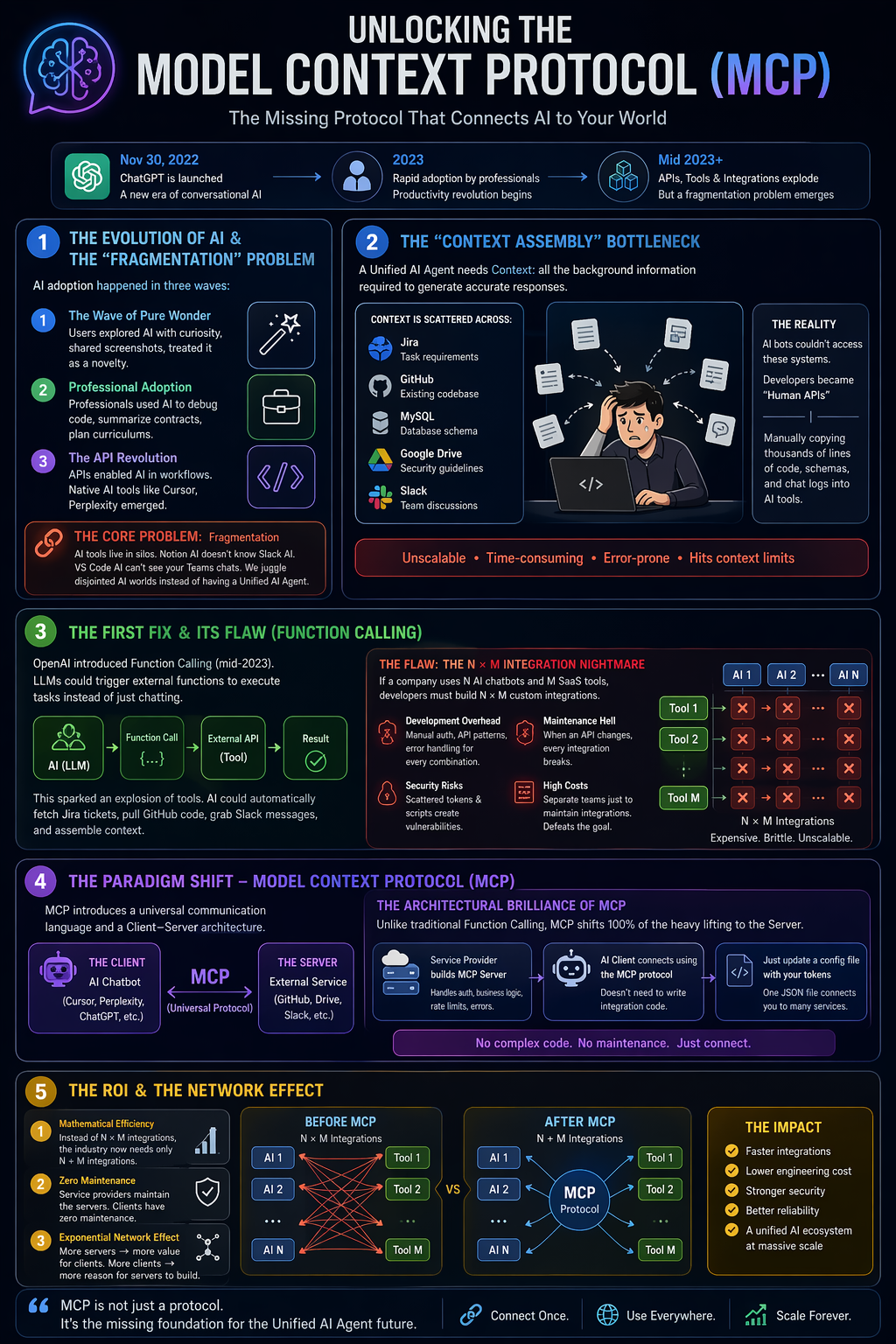
Phase 1: The Evolution of AI and the “Fragmentation” Problem
To understand why MCP exists, we must first look at the historical timeline of AI adoption following the launch of ChatGPT on November 30, 2022. ChatGPT fundamentally changed our 500-year relationship with machines from purely transactional (pressing a button to get a result) to conversational (communicating in natural language).
This adoption occurred in three distinct waves:
-
The Wave of Pure Wonder: Users tested the boundaries of the AI with curious, unpractical questions and shared screenshots on social media, treating it as a novelty rather than a tool.
-
Professional Adoption: Professionals (lawyers, coders, teachers) began using the chatbot to debug code, summarize contracts, and plan curriculums, sparking a massive global productivity boom.
-
The API Revolution: OpenAI released GPT APIs, enabling companies like Microsoft and Google to integrate AI into existing workflows (Workspace, Office) and giving rise to native AI tools like Cursor and Perplexity.
The Core Problem: Fragmentation While AI became highly accessible, it resulted in users living in multiple, isolated “AI worlds”. The AI in Notion had no idea what was being discussed in the Slack AI, and the VS Code AI was blind to your Microsoft Teams chats. Instead of realizing the original vision of a Unified AI Agent that could understand and execute end-to-end tasks, users were forced to juggle disjointed AI tools.
Phase 2: The “Context Assembly” Bottleneck
To build a Unified AI Agent, the system needs Context—defined as all the background information an AI needs to see to generate an accurate response.
In a professional software development scenario, context is severely scattered. If a developer needs to build a Two-Factor Authentication (2FA) system, the necessary context exists across:
- Jira: For task requirements.
- GitHub: For the existing codebase.
- MySQL: For the database schema.
- Google Drive: For security compliance guidelines.
- Slack: For team discussions.
Because AI bots natively lacked access to these systems, developers were forced to become “Human APIs.” Users had to manually copy thousands of lines of code, database schemas, and chat logs to paste them into ChatGPT before finally asking a question. This manual context assembly was unscalable, incredibly time-consuming, and prone to context-window limits or human error.
Phase 3: The First Fix and Its Flaw (Function Calling)
To solve the manual copy-pasting problem, OpenAI introduced Function Calling in mid-2023. This allowed LLMs to trigger external functions (like load_file or fetch_weather) to execute tasks directly rather than just chatting.
This sparked an explosion of “Tools.” Developers built integrations connecting their AI to Salesforce, Slack, GitHub, and local file systems. With tools, an AI could automatically fetch a Jira ticket, pull the latest GitHub code, and grab Slack messages to assemble its own context.
The Flaw: The $N \times M$ Integration Nightmare While Function Calling solved context assembly, it created a massive engineering bottleneck. If a company uses $N$ different AI chatbots (e.g., ChatGPT, Perplexity, Cursor) and relies on $M$ different SaaS tools (e.g., GitHub, Slack, Jira), developers had to write and maintain $N \times M$ custom integrations.
This approach is fundamentally broken for several reasons:
- Development Overhead: Engineers have to manually code authentication, API patterns, and error handling for every single combination of AI and software tool.
- Maintenance Hell: If an API (like Google Drive) updates, every single integration across all chatbots breaks and must be manually debugged.
- Security Risks: Managing authentication tokens across dozens of scattered integration scripts leads to fragmented and vulnerable security models.
- High Costs: Companies had to hire separate development teams just to manage these custom integrations, defeating the initial goal of saving time.
Phase 4: The Paradigm Shift - Model Context Protocol (MCP)
To permanently solve the $N \times M$ integration nightmare, Anthropics created the Model Context Protocol (MCP). MCP introduces a universal communication language and a strict Client-Server architecture.
- The Client: The AI Chatbot (e.g., Cursor, Perplexity, ChatGPT).
- The Server: The external service hosting the data (e.g., GitHub, Google Drive, Slack).
The Architectural Brilliance of MCP: Unlike traditional Function Calling where the client (the AI developer) has to write the integration code to fetch data from an API, MCP shifts 100% of the heavy lifting to the Server.
If GitHub creates an MCP Server, that server handles all the business logic, authentication, rate limiting, and error handling. The AI Client literally does nothing except connect to the server using the shared MCP language. To connect your AI chatbot to multiple services, you no longer write complex integration code; you simply update a single configuration file (like a JSON file) with your personal access tokens.
Phase 5: The ROI and The Network Effect
MCP completely transforms the AI ecosystem economics:
-
Mathematical Efficiency: Instead of building $N \times M$ integrations, the industry now only needs $N + M$ integrations. Software providers build their MCP Server once, and it automatically works with any AI Client.
-
Zero Maintenance: Because the service provider maintains the server, client-side developers have zero maintenance overhead when APIs change.
-
Exponential Network Effect: Major AI tools (Claude Desktop, Cursor, Perplexity) have officially adopted MCP. Because users now prefer pulling data directly through their AI interfaces rather than logging into standard web apps, legacy SaaS companies (like Google Drive or Jira) are under immense pressure to build official MCP servers to retain their users.
As more servers are built, new AI clients natively adopt MCP to instantly access thousands of integrations on Day 1. This compounding feedback loop is exactly why MCP is rapidly cementing itself as the inevitable standard for the AI software industry.
🔥 One-Line Summary
MCP turns AI integrations from a scaling nightmare into a plug-and-play ecosystem.
🧭 Final Takeaway
MCP is not just a feature — it’s a protocol shift.
It transforms AI from:
❌ Tool-based integrations ➡️ to ✅ Standardized ecosystem connectivity