Introduction to LangChain
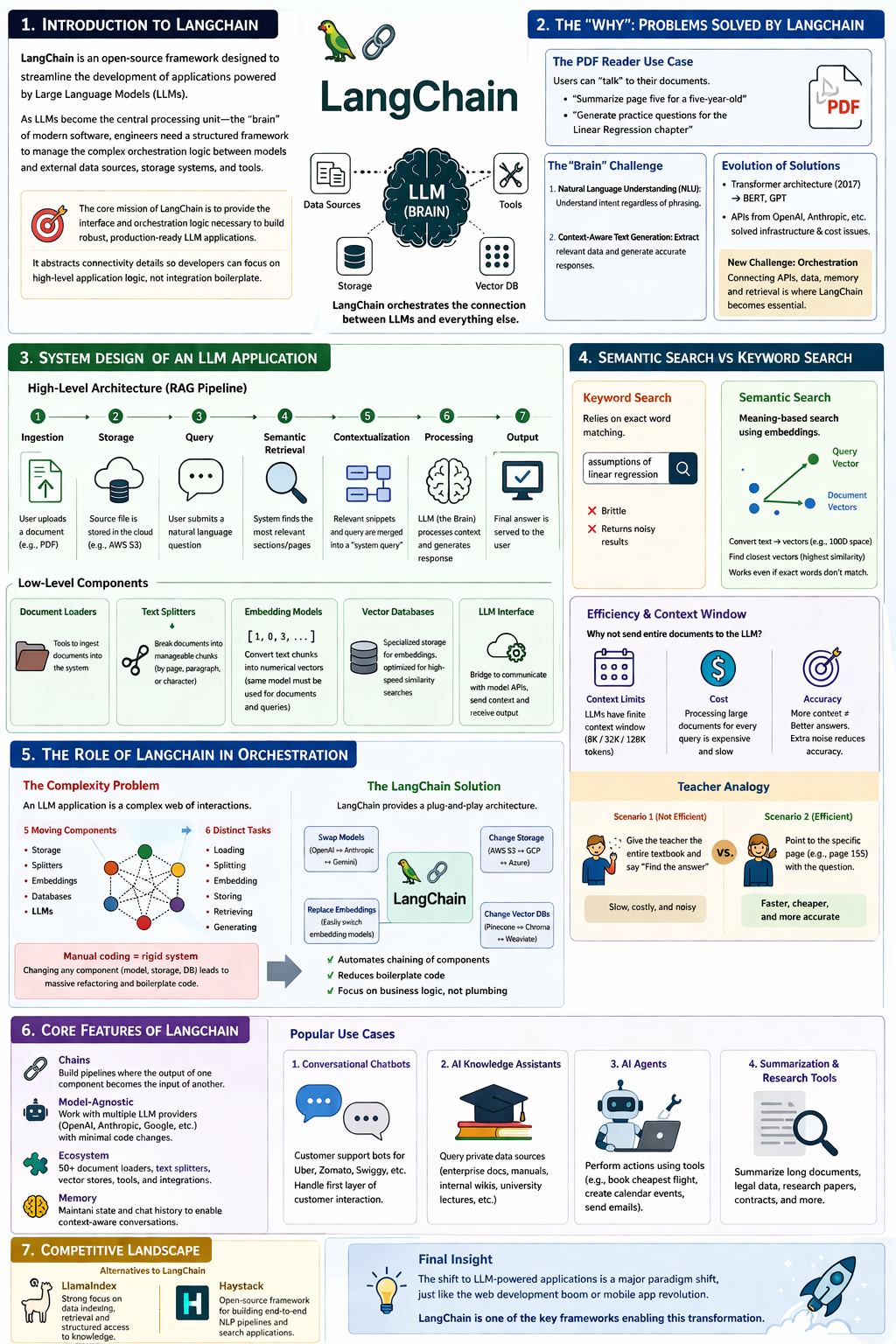
Introduction to LangChain
LangChain is an open-source framework specifically designed to streamline the development of applications powered by Large Language Models (LLMs). As LLMs become the central processing unit the “brain” of modern software, engineers require a structured framework to manage the complex orchestration logic between these models and external data sources, storage systems, and specialized tools.
The core mission of LangChain is to provide the interface and orchestration logic necessary to build robust, production-ready LLM applications. By abstracting the connectivity details, it allows developers to focus on higher-level application logic rather than the underlying integration boilerplate.
The “Why”: Problems Solved by LangChain
The PDF Reader Use Case
Imagine building an application where users can “talk” to their documents. Instead of manually scanning a 1,000-page PDF, a user might ask: “Summarize page five for a five-year-old” or “Generate practice questions for the Linear Regression chapter.”
The “Brain” Challenge
Building this requires a “Brain” capable of two distinct technical feats:
-
Natural Language Understanding (NLU): The ability to Understand intent regardless of phrasing.
-
Context-Aware Text Generation: The ability to extract specific data from a document and synthesize a coherent, accurate response.
The Evolution of Solutions
Historically, developing these capabilities was a monumental engineering hurdle. The breakthrough came with the 2017 “Attention is All You Need” paper, which introduced the Transformer architecture. This led to models like BERT and GPT, which finally cracked the code on NLU and generative text.
Today, providers like OpenAI and Anthropic offer these “brains” via APIs. This solved two massive problems for engineering teams:
-
Inference Engineering: You no longer need to manage the infrastructure required to host and run multi-billion parameter models.
-
Cost Management: APIs allow for a pay-as-you-go model, avoiding the massive capital expenditure of local GPU clusters.
However, a new challenge emerged: Orchestration. Connecting these APIs to your data, managing state, and handling retrieval is where LangChain becomes essential.
System Design of an LLM Application
High-Level Architecture
The data flow of a standard RAG (Retrieval-Augmented Generation) application follows this pipeline:
-
Ingestion: User uploads a document (e.g., a PDF).
-
Storage: The source file is stored in a cloud environment (e.g., AWS S3).
-
Query: The user submits a natural language question.
-
Semantic Retrieval: The system identifies the specific sections or pages relevant to the query.
-
Contextualization: Relevant snippets and the user query are merged into a “system query.”
-
Processing: The LLM (the Brain) processes the context and generates the response.
-
Output: The final answer is served to the user.
Low-Level Component Analysis
To execute this, engineers must manage several technical entities:
-
Document Loaders: Tools to ingest documents into the application environment.
-
Text Splitters: Components that break documents into manageable “chunks” (by page, paragraph, or character).
-
Embedding Models: Models that convert text chunks into numerical vectors. To ensure a consistent vector space, the same model must be used for both document chunks and user queries.
-
Vector Databases: Specialized storage for embeddings, optimized for high-speed similarity searches.
-
The LLM Interface: The bridge communicating with model APIs to send context and receive output.
Technical Deep Dive: Semantic Search vs. Keyword Search
Keyword Search
Keyword search relies on literal word matching. If you search “assumptions of linear regression,” the system looks for those exact strings. This is often brittle and returns noise if those words appear in irrelevant contexts.
Keyword Search
- Matches exact words
- Example: “assumptions of linear regression”
- Fails if wording changes
- Returns noisy results
Semantic Search Process
Semantic search is “meaning-based.” It converts text into N-dimensional vectors (embeddings) using techniques like Word2Vec, Doc2Vec, or BERT.
-
Vector Space Mapping: Imagine a 100-dimensional space. A paragraph about “Virat Kohli’s runs” is converted into a 100-dimensional vector.
-
Similarity Calculation: When a query like “How many runs did Virat score?” is submitted, it is also converted into a 100-dimensional vector. The system calculates the distance between the query vector and the document vectors. The closer the distance, the higher the semantic similarity. This works even if the exact words don’t match, as the “meaning” of the vectors is aligned.
- Convert text → vectors (e.g., 100-dimensional space)
- Convert query → vector
- Measure similarity (distance)
Efficiency Logic & The Context Window
Why not send the whole 1,000-page book to the LLM?
-
Context Window Limitations: Most LLMs have a finite context length (e.g., 8k, 32k, or 128k tokens). A massive book will exceed this window.
-
Computational Cost: Processing 1,000 pages for every query is prohibitively expensive and slow.
-
Accuracy: The Teacher/Student Analogy. If a student has a question about Algebra, they can hand the teacher a textbook and say “Please find the answer” (Scenario 1), or they can point specifically to page 155 (Scenario 2). In Scenario 2, the teacher (LLM) provides a faster, more accurate response because the noise is filtered out.
The Role of LangChain in Orchestration
The Complexity Problem
An LLM application is a “complex web” of interaction. You are managing five moving components (Storage, Splitters, Embeddings, Databases, and LLMs) across at least six distinct tasks (Loading, Splitting, Embedding, Storing, Retrieving, and Generating).
Coding this manually creates a rigid system. If you decide to swap your embedding model, move from AWS S3 to Google Cloud Storage (GCP), or switch from OpenAI to Google Gemini to save costs, you face a massive refactoring headache and extensive boilerplate code.
The LangChain Solution
LangChain offers a “Plug and Play” interface that eliminates this maintenance burden. It allows engineers to:
-
Swap providers (e.g., OpenAI to Anthropic) with minimal code changes.
-
Automate the hand-off between components so that the output of a splitter flows directly into an embedding model.
-
Focus on business logic rather than the plumbing of API integrations.
Core Features of the LangChain Framework
| Pillar | Description | | :— | :— | | Chains | Logic pipelines where the output of one component is the input for the next. Supports complex, parallel, and conditional branching. | | Model-Agnostic Development | Decouples the application from the model provider. Switch LLM APIs with as little as two lines of code. | | Extensive Ecosystem | Access to 50+ text splitters and hundreds of integrations for loaders, embedding models, and vector stores. | Memory & State Handling Manages “Conversation Memory.” It maintains state across turns, ensuring the model knows “this algorithm” refers to “Linear Regression” from a previous query.
Popular Use Cases for LangChain
-
Conversational Chatbots: Scaling customer support for internet giants like Uber, Zomato, and Swiggy, where AI handles the first layer of communication before routing to humans.
-
AI Knowledge Assistants: Assistants indexed on private data, such as internal company wikis or specific university course lectures.
-
AI Agents: “Chatbots on Steroids” that utilize tools to execute actions. An agent doesn’t just suggest a flight; it uses a tool to search, compare, and book the cheapest flight for the user.
-
Summarization & Research Helpers: Processing massive volumes of internal research or private legal documents that cannot be uploaded to public tools like ChatGPT due to privacy or context length constraints.
The Competitive Landscape
While LangChain is the industry leader, engineers should be aware of the broader ecosystem:
-
LlamaIndex: Particularly optimized for data indexing and retrieval tasks.
-
Haystack: A strong alternative for building end-to-end LLM orchestration/pipelines.
Final Insight
The shift to LLM-powered applications is a major paradigm shift, similar to:
- Web development boom
- Mobile app revolution
👉 LangChain is one of the key frameworks enabling this transformation.