LangChain Models
Introduction to the LangChain Model Component
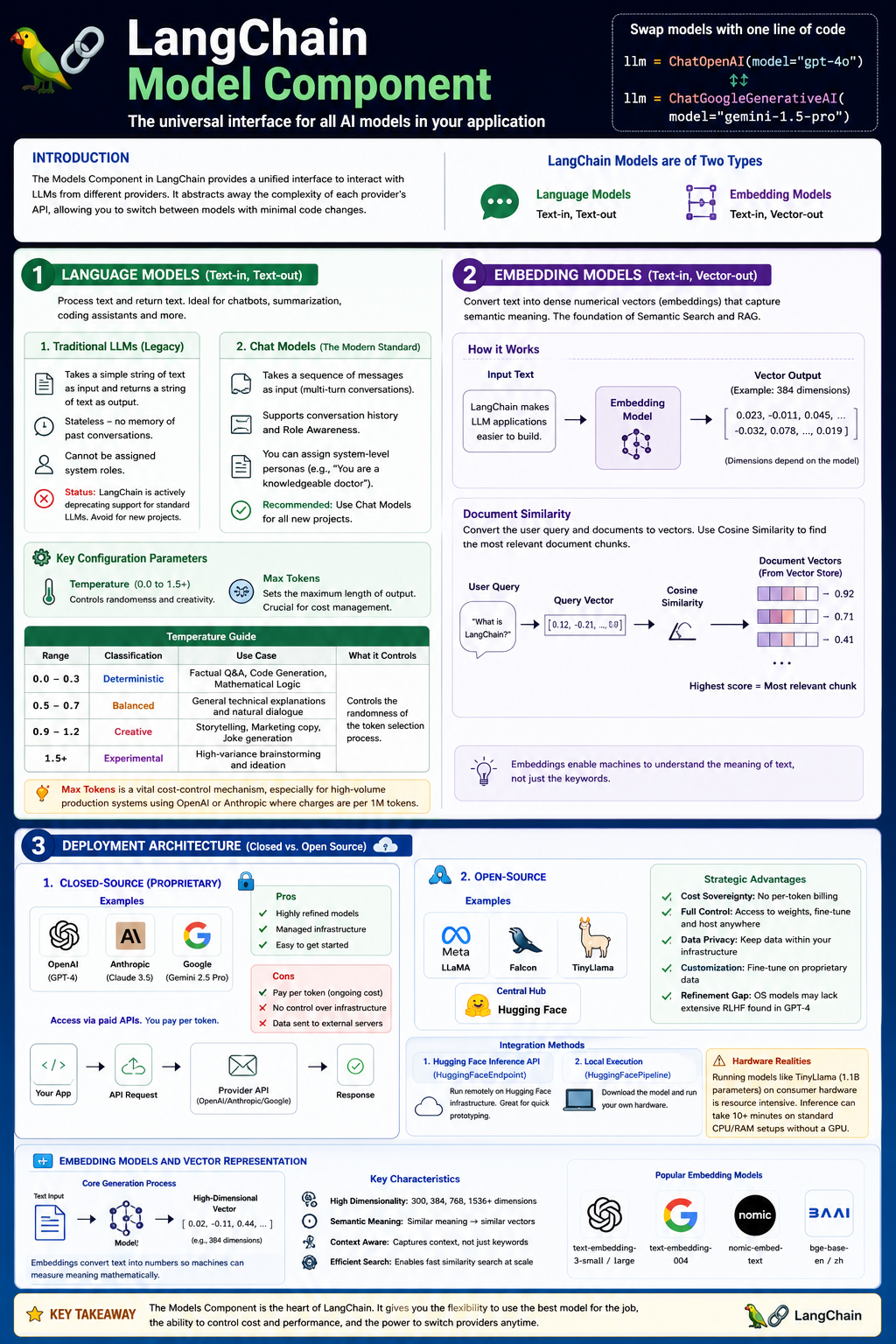
The biggest friction point in AI engineering is that every AI company (OpenAI, Google, Anthropic) builds their APIs differently. The Models Component in LangChain solves this by acting as a universal, common interface. Once you learn LangChain’s syntax, you can swap out an OpenAI model for a Google model by changing just a single line of code, while keeping the rest of your application logic identical.
LangChain divides all AI models into two distinct categories: Language Models and Embedding Models.
-
Language Models: Interfaces designed to process text-based inputs and generate text-based outputs, facilitating natural language reasoning.
-
Embedding Models: Specialized models that transform discrete text into Contextual Vectors (numerical arrays), capturing semantic meaning for search and retrieval.
Pillar 1: Language Models (Text-in, Text-out)
Language models process text and return text, making them ideal for chatbots, summarization, and coding assistants. However, you must understand a critical architectural shift happening right now: the distinction between LLMs and Chat Models.
1. Traditional LLMs (Legacy)
-
Mechanics: These are general-purpose models that take a simple string of text as input and return a string of text as output.
-
The Problem: They are “stateless,” meaning they have no memory of past conversations, and they cannot be assigned specific system roles.
-
Status: LangChain is actively deprecating support for standard LLMs. For new projects, it is highly recommended to avoid them.
2. Chat Models (The Modern Standard)
-
Mechanics: These are specialized for multi-turn conversations. Instead of a single string, they take a sequence of messages as input.
-
Superpowers: Chat models support conversation history and Role Awareness. You can assign them system-level personas (e.g., “You are a knowledgeable doctor”), which fundamentally alters how they process the user’s input.
Key Configuration Parameters:
When configuring your Language Models, you have two primary levers to control their behavior:
- Temperature (0.0 to 1.5+): This controls the model’s randomness and creativity. Use a low value (0.0 - 0.3) for deterministic tasks like coding or math, and a higher value (0.9+) for creative tasks like story writing.
Temperature Controls the randomness of the token selection process.
Range Classification Use Case 0.0 - 0.3 Deterministic Factual Q&A, Code Generation, Mathematical Logic 0.5 - 0.7 Balanced General technical explanations and natural dialogue 0.9 - 1.2 Creative Storytelling, Marketing copy, Joke generation 1.5+ Experimental High-variance brainstorming and ideation
- Max Tokens: This restricts the maximum length of the output, which is crucial for managing your API costs. It is a vital cost-control mechanism, especially for high-volume production systems using OpenAI or Anthropic where charges are per 1M tokens.
Pillar 2: Embedding Models (Text-in, Vector-out)
Embedding models do not answer questions. Instead, you give them text, and they return an array of numbers (a vector). This is the foundational technology behind Semantic Search and Retrieval-Augmented Generation (RAG).
-
How it Works: By converting a document into a dense mathematical vector (e.g., 300 or 384 dimensions), the model captures the deeply contextual meaning of the text. Dimensions are depends on the model you are using.
-
Document Similarity: To find the answer to a user’s question within a private database, you convert the user’s query into a vector, and use Cosine Similarity (via libraries like
scikit-learn) to calculate the angle between the query vector and your document vectors. The document with the highest similarity score contains your answer.
Pillar 3: Deployment Architecture (Closed vs. Open Source)
As an engineer, you must choose where your models run.
1. Closed-Source (Proprietary)
-
Examples: OpenAI (GPT-4), Anthropic (Claude 3.5), Google (Gemini 2.5 Pro).
-
Pros/Cons: You access these via paid APIs (paying per token). They are highly refined, but you have zero control over the infrastructure, and you must send your data to external servers.
2. Open-Source
Open-source models provide an alternative to the “black box” nature of proprietary APIs, though they come with distinct trade-offs.
- Examples: LLaMA, Falcon, TinyLlama. The central hub for these models is Hugging Face.
Strategic Advantages of Open Source
Cost Sovereignty: Eliminates per-token billing in favor of infrastructure costs.
Full Control: Access to model weights allows for deep fine-tuning and hosting flexibility.
Data Privacy: Compliance-heavy industries can process data within local VPCs.
Customization: Fine-tuning on proprietary data exceeds the capabilities of standard prompting.
Refinement Gap: Note that OS models often lack the extensive RLHF (Reinforcement Learning from Human Feedback) found in GPT-4, potentially leading to less “polished” responses.
Integration Methods
-
Hugging Face Inference API (
HuggingFaceEndpoint): Remote execution on Hugging Face infrastructure. Best for quick prototyping. -
Local Execution (
HuggingFacePipeline): Downloads the model to local hardware.- Hardware Realities: Running a model like TinyLlama (1.1B parameters) on consumer-grade hardware is taxing. In testing, inference can take upwards of 10 minutes on standard CPU/RAM setups without dedicated GPU acceleration.
Embedding Models and Vector Representation
Embeddings convert text into high-dimensional vectors, enabling mathematical comparison of “meaning.”
Core Generation Methods
- embed_query: Optimized for single-sentence processing (e.g., a search query).
- embed_documents: Optimized for batch processing of multiple text blocks.
Vector Dimensions and Contextual Capture
The choice of model dictates the “Vector Dimension” size, which represents the resolution of the semantic space:
- 384 Dimensions: Standard for all-MiniLM-L6-v2. High speed, lower resolution.
- 3072 Dimensions: The default for text-embedding-3-large. Captures deep nuance but increases storage and search latency.
Engineering Best Practices
Before you write your code, always set up a secure environment:
-
Virtual Environments: Always create an isolated Python environment (
python -m venv venv) to avoid dependency conflicts. -
Secret Management: Never hardcode your API keys. Use a
.envfile and thedotenvlibrary to securely load keys at runtime. -
The
invokeMethod: Whether you are using a Chat Model or an Embedding Model, LangChain relies heavily on the universal.invoke()method to trigger the model’s processing.
Review the formal Mastery Document artifact once it finishes generating, and let me know if you would like to test your knowledge with a custom quiz or flashcards!